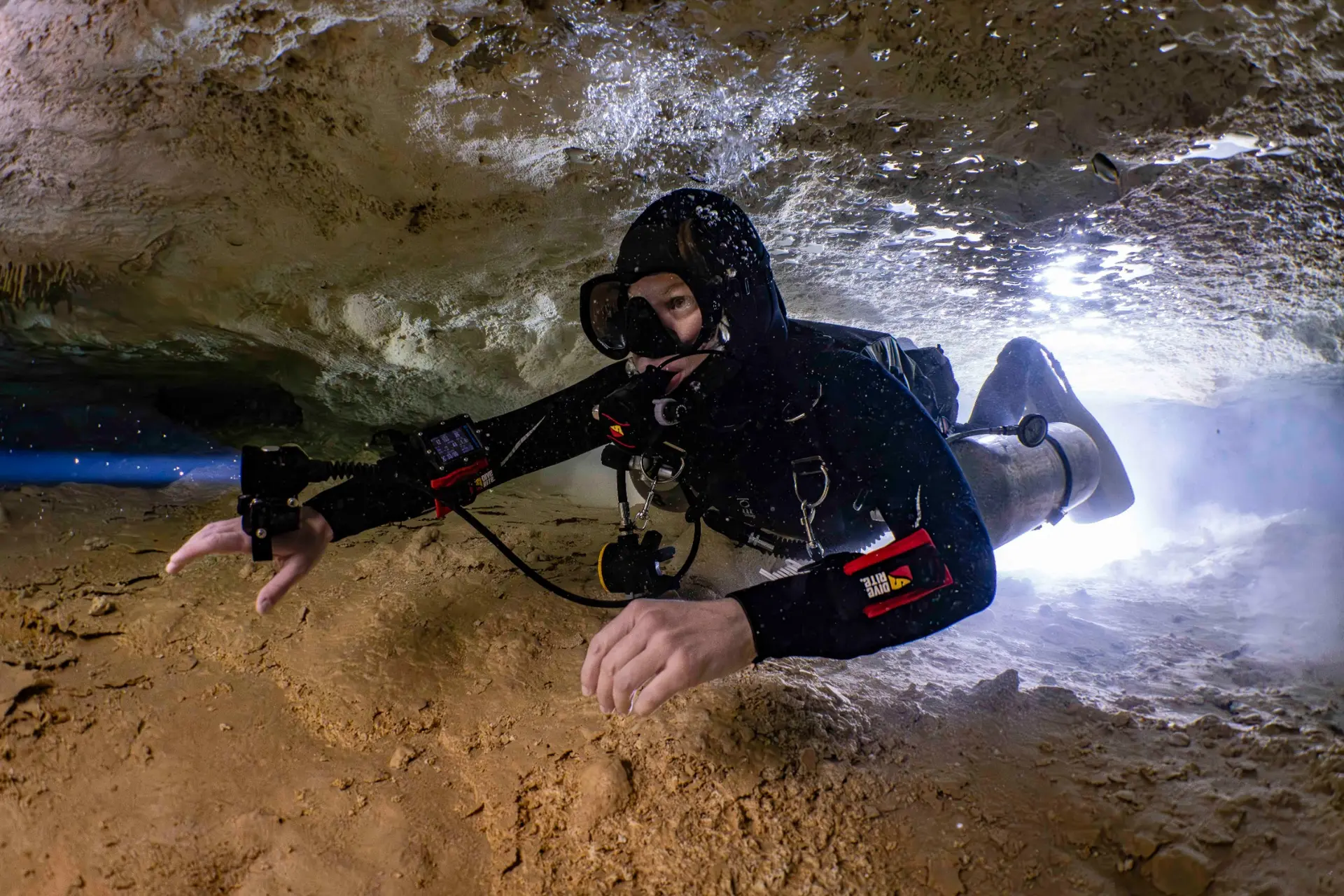
Cave diver practicing overhead-environment skills

Train · Cave

A disciplined progression into overhead environments.

A clearly sequenced cave curriculum built around safety, conservation, limits and performance.

Standards connected to this pathway

Agency roles with a clear purpose.

Understand our standards
National Speleological Society Cave Diving Section

NSS-CDS

Cave Instructor · Instructor #386Specialized cave-diving standards, safety, exploration and conservation.
SDI, TDI and First Response Training International

TDI

Instructor TrainerTechnical, decompression, rebreather and instructor-level development.
01

Private cave training

Progress at the pace competence requires.

Quintana Roo includes more than 1,500 km of explored underwater passage, and Playa del Carmen is surrounded by more than 500 km of caves and passages. Open each course to review its limits, theory, land drills and water skills.

Cavern Diver

A safety and awareness course for open-water divers. It teaches students to recognize the errors associated with cave-diving fatalities, understand overhead-environment hazards, improve buoyancy, breathing, trim, propulsion and awareness, work as a team, and dive safely within the daylight zone while keeping the entrance clearly visible.

Course limits
  • Remain in the daylight zone and within clear sight of the entrance.
  • Penetration gas is limited to 1,150 litres / 40 cubic feet or one-third of the available starting volume, whichever is less.
  • Minimum starting gas volume: 1,150 litres / 40 cubic feet.
  • Maximum penetration distance: 60 metres / 200 feet from the surface.
  • Maximum depth: 30 metres / 100 feet.
  • Minimum starting visibility: 12 metres / 40 feet.
  • No planned decompression.
  • No restrictions too small for two divers to pass side by side.
Theory
  • The cavern environment and accident analysis.
  • Cavern formation and environmental hazards.
  • Equipment and dive planning.
  • Cavern-diving skills and procedures.
  • Teamwork and communication.
  • Buoyancy, breathing, trim, propulsion and awareness.
  • Prevention and management of problems and emergencies.
Land drills
  • Deploy and retrieve a primary reel or spool, including tie-offs and placements.
  • Assist a teammate deploying and retrieving the primary reel.
  • Follow a line without visibility using touch-contact and bump-and-go techniques.
  • Deploy a safety reel or spool.
  • Respond to light failure and practice gas sharing.
Water skills
  • Complete pre-dive checks and safety drills.
  • Install and retrieve a primary reel or spool, tie-offs and placements.
  • Protect the cavern environment and assist the teammate managing the primary reel.
  • Respond to a primary-light failure by deploying a backup light and signaling teammates.
  • Exit while sharing gas for at least 20 metres / 65 feet in good visibility, as both donor and receiver.
4 daysUSD 350 per day

Intro to Cave Diver

Ready to continue from the TDI Cavern Diver course and expand the skills developed in previous overhead-environment training? Intro to Cave introduces the basic principles of cave diving along a single primary guideline. It is the second level in the development of sound cave-diving technique and refines cavern skills while adding the procedures required for elementary cave dives. It is not intended to train divers for every facet of cave diving.

Course limits
  • Penetration gas is limited to 1,400 litres / 50 cubic feet or one-third of the available starting volume, whichever is less.
  • Minimum starting volume: 2,100 litres / 75 cubic feet; minimum penetration gas: 700 litres / 25 cubic feet.
  • Maximum penetration distance: 300 metres / 1,000 feet from the surface.
  • Maximum depth: 30 metres / 100 feet.
  • Minimum starting visibility: 10 metres / 30 feet.
  • No jumps or gaps to offshoot or continuation lines.
  • No planned decompression, stage cylinders, DPVs or original exploration.
Theory
  • The cave environment and accident analysis.
  • Landowner relations and conservation.
  • Cave formation and environmental hazards.
  • Equipment and dive planning.
  • Cave-diving skills and procedures.
  • Teamwork and communication.
  • Buoyancy, breathing, trim, propulsion and awareness.
  • Problem prevention, emergency management and cave-diving etiquette.
Land drills
  • Deploy and retrieve a primary reel or spool, including tie-offs and placements.
  • Follow a line without visibility using touch-contact and bump-and-go techniques.
  • Share gas with eyes open and without visibility.
  • Respond to light failure, a lost diver and a lost line.
Water skills
  • Complete pre-dive checks and safety drills.
  • Deploy and retrieve the primary guideline.
  • Follow a line without visibility using touch-contact and bump-and-go techniques.
  • Share gas with eyes open and without visibility.
  • Follow a guideline for at least 15 metres / 50 feet without a mask.
  • Deploy a safety reel or spool and demonstrate appropriate propulsion techniques.
  • Respond to light failure, a lost diver and a lost line.
4 daysUSD 350 per day

Full Cave Diver

Build on the knowledge, skills and experience developed during Intro to Cave. The course introduces complex navigation with jumps, T-intersections and gaps, plus the theory and procedures for circuits and traverses that require a halfway point or point of no return. Where appropriate, students also learn to apply existing open-water decompression training to the cave environment.

Course limits
  • Penetration is limited to one-third of the available starting gas volume.
  • Minimum starting volume: 2,100 litres / 75 cubic feet; minimum penetration gas: 700 litres / 25 cubic feet.
  • Maximum depth: 40 metres / 130 feet.
  • Minimum starting visibility: 6 metres / 20 feet.
  • No DPVs.
Theory
  • Dive planning and complex navigation.
  • Circuits, traverses and directional and non-directional markers.
  • Cave-diving skills and procedures, including restrictions.
  • Teamwork, communication and task loading.
  • Problem prevention, emergency management and cave-diving etiquette.
Land drills
  • Complex navigation with jumps, gaps and T-intersections.
  • No-visibility line following with touch-contact and bump-and-go techniques.
  • Entanglement, line cutting and line repair.
Water skills
  • Complete pre-dive checks and safety drills.
  • Master buoyancy, trim and propulsion while task loaded.
  • Execute complex navigation, circuits and traverses.
  • Follow the line without visibility using touch-contact and bump-and-go techniques.
  • Complete gas-sharing and emergency scenarios.
  • Negotiate restrictions and respond to entanglement, line cuts and line repairs.
4 daysUSD 350 per day

Complete Cave Diving Progression

A continuous Cavern, Intro to Cave and Full Cave progression designed to provide repetition, coaching and skill consolidation from the daylight zone through complex cave navigation. Progression remains performance based, and additional training days may be required to meet every objective safely.

10 days minimumUSD 350 per day

Cave Sidemount

Develop the configuration, trim, gas management and problem-solving skills required to use sidemount effectively in caves. Training focuses on disciplined equipment placement, team procedures, restriction management and the preservation of precise control in an overhead environment.

2 daysUSD 350 per day

Advanced Cave Diver

An alternative to the NSS-CDS Cave Diver course. It includes all academic and in-water skill development from the complete Cave Diver course, together with the content and training of the NSS-CDS Stage Diving specialty and the First Responder program.

2 daysUSD 350 per day

Stage Cave Diver

Learn to extend cave penetration and bottom time safely through the disciplined use of one or more stage cylinders. The course emphasizes stage placement and retrieval, gas planning, team positioning, cylinder identification and contingency management without compromising fundamental cave-diving limits.

3 daysUSD 350 per day

Cave DPV Diver

Develop the fundamentals of safe diver-propulsion-vehicle operation in underwater caves. Training addresses DPV configuration, tow-behind gas planning, team communication, speed and positioning, turn points, failures and emergency procedures in an overhead environment.

4 daysUSD 350 per day

Trimix Cave Diver

Develop the planning and execution skills required for mixed-gas cave diving to a maximum of 90 metres / 300 feet. This advanced program integrates cave protocols, decompression, gas selection, team procedures, bailout planning and the added task loading of deep overhead-environment diving.

CCR Cave Diver

The third stage of the TDI rebreather cave-diving progression. Qualified CCR cave divers develop advanced planning and execution skills across different cave environments, configurations and emergency scenarios while managing the specific demands of a closed-circuit unit in an overhead environment.

CCR Cave Crossover

Divers certified as TDI Full Cave Diver or equivalent and TDI Air Diluent CCR Decompression Procedures Diver or equivalent may upgrade to TDI Rebreather Full Cave Diver by completing the applicable crossover requirements.

Crossover requirements
  • Complete four cave dives with at least 240 minutes of accumulated bottom time at two different sites.
  • At least two of the dives must be 75 minutes or longer.
  • All remaining course requirements must be met.
02

Included

Core training support.

The following services are included when applicable to the selected course and configuration.

  • Private instructor and classroom sessions.
  • Transportation from the shop to the cenote or boat.
  • Required single, sidemount or doubles cylinders where applicable.
  • Weights and EAN32 fills where applicable.
  • Certification card.
  • Water and snacks.
03

Not included

Plan for site, gas and equipment costs.

These items are quoted or paid separately because requirements vary by course, site and diver.

  • Cenote entrance fees: USD 15–30 per person, per day.
  • Oxygen, decompression gases and trimix where applicable.
  • Lunch, course manual or eLearning.
  • Personal scuba and cave-diving equipment.
  • Specialized equipment rental; CCR unit rental is USD 70 per day.

Next step

Discuss cave training.

Discuss cave training
WhatsApp